
Preparing for an AI engineer coding interview means learning how to build an application that uses a language model and demonstrating that you understand its behavior beyond a successful demo. You should be able to explain how information reaches the model, how you check the response, and what happens when the application encounters missing evidence, slow dependencies, or unauthorized requests.
Understanding retrieval-augmented generation, or RAG, is a useful starting point. However, practical preparation requires more than remembering its definition. You need to know how to retrieve relevant passages, preserve document permissions, handle provider failures, and evaluate whether an answer is supported by the information supplied.
The same applies to vector embeddings, prompt chaining, and latency optimization. A strong explanation connects the concept to an implementation decision. Instead of saying that caching makes an application faster, explain what you would cache, how you would invalidate it, and how you would prevent one user from receiving another user’s private answer.
This guide focuses on applied AI software engineering: building applications around language models, retrieval systems, and supporting services. It is intended for professionals, career switchers, and students preparing for these roles in the United States and Canada.
Interview formats vary by employer. The questions and exercises below are original practice material based on engineering documentation. Use them to strengthen your reasoning and implementation skills rather than treating them as a prediction of a particular company’s assessment.
What Kind of AI Engineer Interview Are You Preparing For?
The title “AI engineer” can describe several different jobs. An applied AI engineer might build a document assistant using an existing model, while a machine learning engineer might maintain training pipelines. An infrastructure engineer could work on model serving, and a researcher might focus on experiments or mathematical methods.
Your preparation should follow the responsibilities in the job description. If the employer mentions copilots, retrieval, agents, APIs, or customer-facing LLM features, application engineering should be a priority. If it emphasizes model training, optimization algorithms, or research publications, you will need additional preparation beyond this guide.
| Role emphasis | Preparation priorities |
| Applied AI software engineering | APIs, retrieval, prompts, evaluation, security, application code |
| Machine learning engineering | Data pipelines, training, deployment, model evaluation |
| AI infrastructure | Serving, distributed systems, performance, reliability |
| AI research | Mathematical foundations, experiments, research methods |
Confirm the Assessment Rules
Before practicing, ask the recruiter how the assessment works. Find out whether you can choose your programming language, whether you will start from an existing repository, and whether external APIs will be available. Also clarify whether the exercise focuses on implementation, debugging, or system design.
Documentation and AI-assistant rules deserve an explicit answer. Some assessments may permit external tools, while others restrict them. Understanding those conditions lets you practice in a comparable environment and avoids making assumptions during the test.
For a take-home exercise, clarify what the employer expects you to submit. A repository, setup instructions, tests, and a short explanation may matter as much as the application itself. For a live exercise, prioritize implementing a small working solution and explaining your decisions within the available time.
The Core Skills to Prepare
An applied AI coding test draws on ordinary software engineering as well as model-specific concepts. You need clear functions, sensible data structures, input validation, asynchronous execution, and reliable error handling. Adding a language model does not remove those foundations.
Retrieval introduces another set of decisions: how documents are divided, how queries are represented, which candidates are selected, and how permissions affect the search. Workflow design adds questions about dependencies and intermediate validation. Performance and evaluation determine whether the resulting application is useful under realistic conditions.
| Area | What to demonstrate |
| Software fundamentals | Clear functions, validation, error handling, asynchronous work |
| Retrieval | Chunking, embeddings, search, filtering, relevance |
| Workflow design | Prompt chaining, structured outputs, dependencies |
| Performance | Measurement, concurrency, caching, token budgets |
| Security | Authentication, authorization, trust boundaries, safe output handling |
| Evaluation | Tests that distinguish retrieval, generation, and operational failures |
You do not need an elaborate architecture to demonstrate these skills. A small application with clear assumptions and meaningful tests gives you a concrete basis for discussing tradeoffs. Complexity should follow the requirements.
1. Vector Embeddings: Explain the Concept and Its Limits
An embedding represents an input as a numerical vector. The model producing that vector is trained so that useful relationships between inputs can be reflected in the resulting space. In semantic retrieval, this allows an application to compare a question with stored document passages and identify potentially relevant material.
OpenAI’s embedding documentation describes applications including search, similarity, and clustering. For interview preparation, focus on what those representations enable and what they cannot establish.
Practice Question: What Is a Vector Embedding?
A useful answer explains both the representation and its role in the system: “An embedding is a numerical representation of an input. For semantic retrieval, I generate compatible query and document embeddings, then compare them using the index’s similarity metric.”
Follow that explanation with the limitation. Retrieved passages are candidates for answering the question, not proof of a correct answer. A highly similar document could be outdated, unauthorized, or related to the topic without containing the information the user needs.
For example, a question about equipment reimbursement could retrieve a document discussing equipment procurement. The topics overlap, but procurement instructions may not explain reimbursement eligibility. Your application still needs a way to assess whether the retrieved evidence supports the requested answer.
Practice Question: Explain Cosine Similarity
Cosine similarity compares the direction of two vectors. It divides their dot product by the product of their magnitudes:
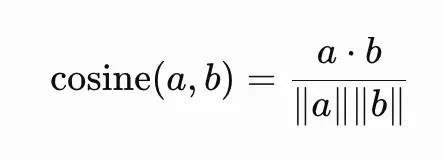
For nonzero vectors, the result lies between −1 and 1. Greater alignment produces a higher score under this metric. However, that score is not a universal probability that a passage contains the right answer.
A small implementation is useful practice because it exposes edge cases that a library might otherwise hide:
import math

def cosine_similarity(a, b):
    if len(a) != len(b):
        raise ValueError("Vector dimensions must match")

    if not a:
        raise ValueError("Vectors must not be empty")

    if not all(math.isfinite(x) for x in (*a, *b)):
        raise ValueError("Vectors must contain finite values")

    dot = sum(x * y for x, y in zip(a, b))
    norm_a = math.sqrt(sum(x * x for x in a))
    norm_b = math.sqrt(sum(y * y for y in b))

    if norm_a == 0 or norm_b == 0:
        raise ValueError("Cosine similarity needs nonzero vectors")

return dot / (norm_a * norm_b)Test identical, orthogonal, and opposite vectors, along with invalid dimensions and zero vectors. Explain why a zero vector is rejected: its direction is undefined for this calculation.
This implementation is an educational baseline. For a large corpus, you would investigate an appropriate search index rather than scanning every stored vector in application code.
Practice Question: Can You Mix Different Embedding Models?
Matching dimensions do not establish compatibility. Two models can produce vectors of the same length while organizing information differently. Comparing those vectors without a compatible retrieval design can produce unreliable results.
Some systems intentionally use different query and document encoders, but those encoders are designed to work together. The requirement is compatibility, not necessarily an identical model name.
In an interview, explain how you would version the embedding configuration. If you change it, build a compatible replacement index, evaluate retrieval, and plan the migration. Avoid silently mixing old document vectors with a new query representation.
Practice Question: How Would You Choose an Embedding Model?
Start with the retrieval task and the documents involved. Evaluate representative questions, including terminology specific to the domain, exact identifiers, and any languages the application needs to support.
Then consider practical constraints such as input limits, hosting, cost, latency, and data handling. A larger embedding is not automatically a better choice. It should justify its storage and processing requirements through useful performance on your task.
A convincing answer describes a comparison process: establish a baseline, measure retrieval quality, inspect failures, and choose the configuration that meets the application’s needs.
2. Retrieval: Move Beyond “Put Documents in a Vector Database”
RAG supplies selected external information to a language model. The retrieval stage determines which evidence is available for generation, so its mistakes can affect the entire response.
Treat retrieval as a pipeline you can inspect. Document extraction, chunking, indexing, filtering, ranking, and context selection each influence what reaches the model.
Practice Question: How Do You Choose Chunk Size?
Chunk size involves a balance between precision and context. Smaller chunks can isolate relevant information, but they may separate a rule from its exceptions. Larger chunks can preserve that relationship while introducing unrelated material and using more of the context budget.
Begin with the document’s structure. A procedure may need its steps kept together, while a table may require headings to remain attached to the values. Arbitrary splitting can lose those relationships even if every chunk fits a token limit.
Evaluate chunking with questions that require different evidence. Include single facts, multi-step procedures, and answers spanning sections. The goal is to determine whether the chosen structure makes the necessary information retrievable.
Practice Question: When Would You Use Hybrid Search?
Semantic search helps when the query and source use different wording. Lexical search helps preserve exact matches, such as product names, policy numbers, and error codes.
A question like “How do I recover access?” may benefit from semantic matching. A question about “error ZX-410” may require the exact identifier to influence retrieval strongly.
Anthropic’s contextual-retrieval guidance discusses combining embeddings with lexical retrieval and using reranking where appropriate. In an interview, describe how you would compare those approaches on your own evaluation questions. Additional components should solve an observed retrieval problem.
Practice Question: What Does a Reranker Do?
A reranker evaluates an initial candidate set against the query and changes the ordering. Its purpose is to improve the selection of passages sent to generation.
The tradeoff is additional computation and potentially another service dependency. Explain how many candidates you retrieve, how many you rerank, and how many you retain. Then describe what improvement would justify the added latency and cost.
Retrieving more candidates and reranking them may help some questions. For others, a simpler search can provide sufficient evidence faster. Measure the difference.
Practice Question: Why Is the Correct Document Not Being Retrieved?
Begin by confirming that the document exists in the index and that extraction preserved the relevant content. Then inspect the chunk containing the answer and check whether metadata filters exclude it incorrectly.
Next, examine the query representation, search configuration, and ranking stages. The document may be found initially but discarded during reranking or context selection. It may also be stale, deleted, or indexed under an incompatible embedding configuration.
This investigation helps locate the failure. Replacing the generation model will not fix a pipeline that never supplies the necessary evidence.
3. Prompt Chaining: Know When Separate Steps Help
Prompt chaining divides work into stages where one stage supplies input to another. For example, an application could extract facts, validate their structure, and then generate a summary from the validated information.
Anthropic distinguishes workflows from agents. A workflow follows predefined paths through code, while an agent can dynamically determine how to proceed. Prompt chaining is one way to structure a workflow.
Practice Question: Why Use a Chain Instead of One Prompt?
Separate stages are useful when you need to inspect an intermediate result, apply different instructions, or validate information before continuing. They also make it possible to evaluate individual parts of the workflow.
However, every added stage creates another place where a request can fail or introduce delay. Start with a simple approach and split the task when a clear requirement justifies it.
For example, extracting an action from a message and executing that action should have a validation boundary between them. The extraction stage proposes a structured interpretation; trusted application logic decides whether the action is valid and authorized.
Practice Question: How Do You Validate an Intermediate Result?
Suppose a stage produces:
{
  "customer_id": "C-104",
  "requested_action": "update_contact_details"
}Check that the required fields exist, their types are correct, and the action belongs to an allowed set. Apply relevant length limits and business rules before passing the result onward.
Then verify authorization independently. Valid JSON does not establish that the requester can update that customer’s information. Structural validation and access control solve different problems.
Practice Question: When Can You Parallelize?
Parallel execution is appropriate when tasks do not depend on one another. Two independent retrieval methods may run concurrently before their results are combined.
Preserve genuine dependencies. If a task requires an earlier result, running it speculatively needs careful reasoning about cost, cancellation, and security. In particular, private content must not reach a downstream model before the required authorization checks.
Explain both the performance opportunity and the boundary that must remain intact.
4. Latency Optimization: Measure Before Changing the System
A slow AI endpoint can involve authentication, embedding generation, retrieval, reranking, provider processing, output validation, or queuing. Without measurement, you can spend time optimizing a stage that contributes little to the overall delay.
Instrument the application at meaningful boundaries. Compare performance under representative load, including slow requests and failures.
Practice Question: Your RAG Endpoint Takes Eight Seconds. What Do You Do?
Start with a trace showing how time is distributed. The following is a hypothetical example, not a benchmark:
| Stage | Example duration |
| Authentication and authorization | 40 ms |
| Query embedding | 180 ms |
| Retrieval | 120 ms |
| Reranking | 450 ms |
| Model request and generation | 6,700 ms |
| Validation and response | 80 ms |
Here, generation dominates the measured work. Reducing retrieval by a few milliseconds would have limited impact. Investigate the generation stage and explain how any proposed change will be checked for answer quality.
A useful approach is to change one part of the critical path, compare results, and check whether latency, error rate, and cost improved without unacceptable quality loss.
Metrics to Know
Time to first token measures when generated output begins arriving. Time to first usable output measures when the application can safely present useful content. These can differ when the response must be fully validated before release.
Total response time measures completion, while p95 latency describes the point below which 95% of observed request durations fall. Tail latency helps reveal slow requests that an average can hide.
Also track errors, throughput, and cost per successful request. A fast response that fails validation should not be counted as an unqualified performance improvement.
Practical Optimization Options
OpenAI’s latency guidance discusses approaches including fewer requests, appropriate model selection, parallel execution, and streaming.
Apply them according to the bottleneck. Remove redundant model calls, use deterministic code for straightforward checks, and evaluate whether a faster model can handle a particular stage. Keep output appropriately concise and avoid supplying unnecessary context.
Use bounded concurrency rather than launching unlimited requests. Recheck quality after changing models, prompts, retrieval, or output limits.
Practice Question: Does Streaming Make the Model Finish Faster?
Streaming allows the user to receive output incrementally. It can improve responsiveness without reducing the time needed to generate the complete answer.
It also affects validation. If your application must inspect the whole response before displaying it, sending tokens immediately may violate that requirement. Explain whether partial output is acceptable and how you handle errors after streaming begins.
Practice Question: What Can You Cache?
Document embeddings, query embeddings, retrieval results, and generated answers are different cache layers. Each depends on different inputs and needs an appropriate invalidation policy.
An answer cache for private information must respect access scope and document freshness. The same question from two users does not mean both should receive the same answer. Changes to permissions or source documents may invalidate a previously safe result.
OWASP’s RAG security guidance discusses cache isolation and invalidation. Be prepared to explain the cache key and the events that make a cached entry unusable.
Alt text: “Illustration of documents and vector embeddings feeding into a coding laptop, with a security shield and speed gauge.”
5. Building a Secure RAG Endpoint
A RAG endpoint needs ordinary application security alongside controls for retrieved content and model output. Consider an internal assistant answering questions about company documents. Its responses must reflect the user’s permissions, even when the knowledge base contains material from several departments.
Security decisions should remain in trusted application logic. A model can help interpret information, but it should not decide whether a user is entitled to receive a document.
Authenticate the Request
Use the application’s established authentication mechanism to identify the requester. A user_id submitted in the request body is a claim, not proof of identity.
The resulting trusted identity should drive access checks. This makes it possible to distinguish who is asking from which resources they are permitted to use.
Authorize the Retrieval Scope
Determine the retrieval scope using server-controlled policy. Depending on the application, access may depend on tenant, department, document classification, or individual permissions.
OWASP’s authorization guidance distinguishes authentication from authorization and recommends relevant permission checks on every request. Being logged in does not establish access to every indexed document.
Filter Before Context Reaches the Model
Use permission-aware retrieval so that unauthorized material is excluded before generation. Metadata filters can help implement this, but the filter values must come from trusted logic.
Pinecone documents metadata filtering as a search capability. Your application still needs to define and enforce the access policy.
For sensitive systems, verify candidates against authoritative permissions before including their content. Do not send private text to a model and rely on instructions to prevent disclosure.
Treat Retrieved Text as Untrusted Content
A retrieved document can contain instructions intended to alter the model’s behavior. This is an indirect prompt-injection risk, even when the application’s original prompt is appropriate.
OWASP’s prompt-injection guidance explains why RAG does not eliminate this problem. Separate document content from trusted instructions, restrict capabilities, and evaluate output handling.
Delimiters can help communicate intended boundaries, but they are not an enforceable authorization mechanism or a guarantee against injection.
Protect the Rest of the Pipeline
Security starts before the user submits a question. Ingestion needs approved sources and reliable provenance. Chunks need appropriate permission metadata, and source changes or deletions need to reach the index.
Consider what appears in logs and whether embeddings, prompts, or retrieved text expose sensitive information. OWASP’s vector and embedding guidance identifies access-control failures, leakage, and poisoned knowledge sources as relevant risks.
Practice Coding Test: A Permission-Aware RAG Endpoint
Build an endpoint that answers a question using company documents. It should retrieve authorized content, cite sources, handle missing evidence, and fail safely when dependencies are unavailable.
Example Request and Response
The request contains the question:
{
  "question": "What is the equipment reimbursement policy?"
}The authenticated session supplies identity. The client does not select its own access scope.
A structured response could look like this:
{
  "answer": "The policy describes eligible equipment and approval steps.",
  "citations": [
    {
      "document_id": "policy-42",
      "chunk_id": "policy-42-section-3"
    }
  ],
  "status": "answered"
}This illustrates the response format, not an actual reimbursement policy. The citation identifiers should correspond to authorized material used in the response.
Clarify the Contract Before Coding
Find out whether authentication and indexing already exist. Clarify the permissions model, the expected citation format, and what should happen when evidence is missing.
Also ask about streaming, response limits, and deadlines. If the exercise leaves these unspecified, state your assumptions and keep them visible in the implementation.
Implementation Outline
The following is provider-neutral pseudocode. The adapters need to enforce the described behavior; this is not a drop-in production implementation.
async def answer_question(request, services):

    user = await services.auth.authenticate(request)
    question = services.validation.question(request.body)
    await services.limits.check(user, question)
    scope = await services.access.resolve_scope(user)

    query_vector = await services.embeddings.embed(
        question,
        deadline=request.deadline,
    )

    candidates = await services.search.query(
        vector=query_vector,
        scope=scope,
        limit=services.config.candidate_limit,
        deadline=request.deadline,
    )

    authorized = await services.access.verify_candidates(
        user=user,
        candidates=candidates,
    )

    passages = services.context.select(
        authorized,
        token_budget=services.config.context_budget,
    )

    if not passages:
        return {
            "answer": "I could not find supporting information.",
            "citations": [],
            "status": "insufficient_evidence",
        }

    draft = await services.model.answer(
        question=question,
        untrusted_passages=passages,
        max_output_tokens=services.config.output_limit,
        deadline=request.deadline,
    )

    validated = services.output.validate_structure(draft)
    services.output.validate_citation_ids(validated, passages)
    await services.access.verify_cited_sources(user, validated)
return validatedExplain the Limitations
Valid citation identifiers do not establish that the cited passages support the answer. Similarly, having retrieved passages does not establish sufficient evidence. Your implementation needs evaluation and a suitable insufficient-evidence policy.
The outline also leaves timeout handling, permission consistency, and adapter behavior to the surrounding system. Explain these limitations rather than implying that the pseudocode guarantees secure or accurate output.
Handle Failures Deliberately
Define safe behavior for invalid input, missing authentication, rate-limit violations, dependency timeouts, and malformed model responses. Return useful error information without exposing credentials, private content, or raw internal exceptions.
OWASP’s REST guidance provides supporting principles for validation, access control, and error handling.
Tests That Make the Exercise Meaningful
Use deterministic fixtures and mocked provider responses to test the application’s own logic. This lets you reproduce failures without relying on live model behavior.
| Test | Expected behavior |
| Missing identity | No retrieval or model call |
| Empty or oversized question | Rejected before expensive work |
| Candidate belongs to another tenant | Never included in model input |
| Permission revoked | Source excluded or request fails safely |
| No useful passages | Explicit insufficient-evidence response |
| Model cites an unknown chunk | Output rejected |
| Provider times out | Bounded failure with safe response |
| Malformed model output | Validation failure |
| Cache entry from another scope | Never served |
Prompt-injection tests should exercise your defined containment policy. Passing one adversarial example does not prove universal resistance, but it can reveal failures and protect against regressions.
Test Citation Support Separately
Citation testing has two layers. First, check whether the identifier refers to an authorized passage supplied to the model. Then evaluate whether that passage actually supports the associated claim.
The first check can be deterministic. The second requires content assessment. Keep them separate so a structurally valid citation does not hide an unsupported answer.
6. Evaluation: Separate Retrieval and Generation
When an answer fails, identify which stage caused the problem. The correct passage might never have been retrieved, or the model might have misinterpreted evidence that was available.
Build an evaluation set with clear answers, multi-passage questions, exact identifiers, ambiguous requests, and unanswerable questions. Include stale documents and restricted content where relevant.
OpenAI’s evaluation guidance recommends task-specific evaluations and continued assessment as systems change.
Retrieval Evaluation
Determine whether the necessary evidence appears in the candidate set and where it is ranked. Recall at a selected candidate count can be useful, but define relevance carefully.
Some questions need several passages. Retrieving one related chunk may not provide enough evidence to answer the whole request.
Answer Evaluation
Evaluate correctness, relevance, support, citation quality, and appropriate abstention. A fluent response can still contain unsupported claims.
Inspect failures individually. This helps distinguish a prompt problem from missing evidence or an incorrect source.
Operational Evaluation
Track latency, errors, cost, timeouts, and access-control behavior. A configuration that improves answer quality may also introduce delays or dependencies.
Explain the tradeoff and the application’s requirements. The goal is a useful system with acceptable performance and security behavior.
How to Approach a Timed Coding Test
Begin by restating the task and clarifying important uncertainties. Describe a small baseline, then implement an end-to-end path before adding optional components.
Prioritize tests around invalid inputs, missing evidence, and trust boundaries. These demonstrate concrete behavior more effectively than an elaborate interface.
As you work, explain consequential decisions. You might describe why retrieval sits behind an interface, why authorization comes from server-side policy, or why you are deferring reranking until you can measure it.
Finish with a clear handoff covering what works, what you tested, your assumptions, and known limitations. Identify the next improvement without describing it as already implemented.
A Four-Week Preparation Plan
Alt text: “Developer practicing coding beside four ascending steps representing coding, research, testing, and interview preparation.”
Use the first week to strengthen coding fundamentals and implement a small retrieval baseline. In the second week, connect retrieval to an endpoint and add permission-aware behavior.
During the third week, build an evaluation set and measure the stages. Use the final week for timed practice and explaining the project without relying on notes.
| Week | Focus | Deliverable |
| 1 | Coding fundamentals and retrieval | Tested search baseline |
| 2 | RAG endpoint and authorization | Permission-aware implementation |
| 3 | Evaluation and performance | Evaluation set and latency report |
| 4 | Timed practice and explanation | Mock assessment and walkthrough |
This is a practice schedule, not a hiring timeline. Beginners should allow more time for APIs, databases, testing, asynchronous code, and authentication.
Common Mistakes in AI Coding-Test Preparation
Memorizing definitions without implementing them leaves important gaps. Build something small enough to inspect, then deliberately test missing evidence and dependency failures.
Avoid adding an agent to a task that has a clear predefined workflow. Extra orchestration creates more behavior to explain and test.
Do not treat similarity scores as confidence or prompts as permission enforcement. Retrieval ranking, factual support, and authorization are separate concerns.
Performance claims also need precision. Streaming does not automatically reduce completion time, and unlimited retries can increase load during a failure. Bound attempts and respect request deadlines.
Finally, understand any AI-generated code you submit and follow the assessment rules. Be able to modify the implementation and explain why it behaves correctly.
Choosing Training for the Next Stage
If you already build applications, focused practice in retrieval, evaluation, and AI workflows may address your gaps. If software fundamentals are unfamiliar, begin with a broader development foundation.
When comparing programs, look at prerequisites, practical assignments, code review, and treatment of security and failure cases. Ask what you will be able to implement independently.
You can explore Metana’s AI Training for Engineers for applied AI study, or review the AI Software Engineering Bootcamp for a broader engineering path. Compare the curriculum with your target roles before choosing.
Frequently Asked Questions
Is an AI Engineer Coding Interview the Same as an ML Interview?
Not necessarily. Applied AI assessments may emphasize application development, retrieval, and reliability. ML assessments may focus more on training, mathematics, and data pipelines. Use the job description and recruiter guidance to establish the emphasis.
Should I Prepare in Python or JavaScript?
Choose a permitted language in which you can implement, debug, and test confidently. Both can support AI applications. Familiarity with the employer’s stack is useful, but clarity and correctness matter in your practice.
Do I Need a Vector Database for Every Exercise?
No. An in-memory baseline can demonstrate retrieval logic for a small dataset. Explain its scaling limits and when an indexed store would become appropriate.
Can I Use an AI Assistant During the Test?
Only when the assessment permits it. Ask in advance and remain responsible for understanding, checking, and modifying the submitted work.
Should I Use a Framework?
Use a framework when it helps meet the requirements and you understand its behavior. Explain what it manages and which responsibilities remain in your application, especially authorization and validation.
Does a Low Temperature Guarantee Correct Answers?
No. Generation settings do not verify evidence, permissions, or citation support. Correctness still needs evaluation.
Should I Learn Fine-Tuning for a RAG-Focused Interview?
Understand the distinction, then prioritize the role. RAG supplies retrieved information during inference, while fine-tuning changes model behavior through training. They address different needs and can be combined.
How Much Mathematics Do I Need?
For applied retrieval, understand vectors, similarity, normalization, and relevant evaluation measures. Research and model-training roles may require deeper mathematical preparation.
What Should I Submit With a Take-Home?
Include setup instructions, tests, assumptions, example requests, dependencies, and limitations. Make the project straightforward to review and keep credentials out of the repository.
Prepare to Build, Measure, and Explain
An AI engineer coding interview gives you an opportunity to demonstrate how you approach an engineering problem. Prepare by building a small application, checking failure cases, measuring its behavior, and explaining its boundaries.
Your goal is to show that you understand both the implementation and the decisions behind it.
Ready to strengthen those skills? Explore Metana’s AI training options and discuss a learning path that matches your coding background and target roles.